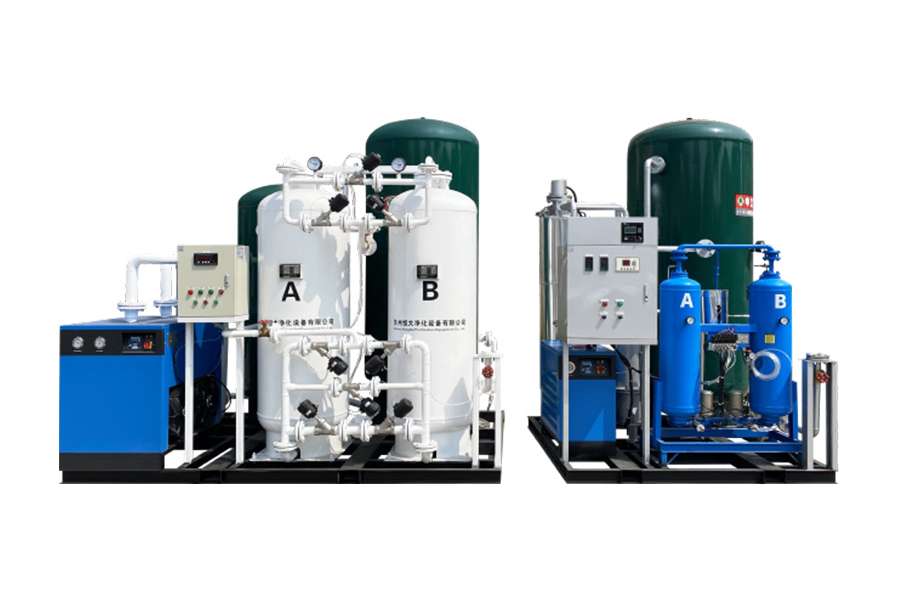
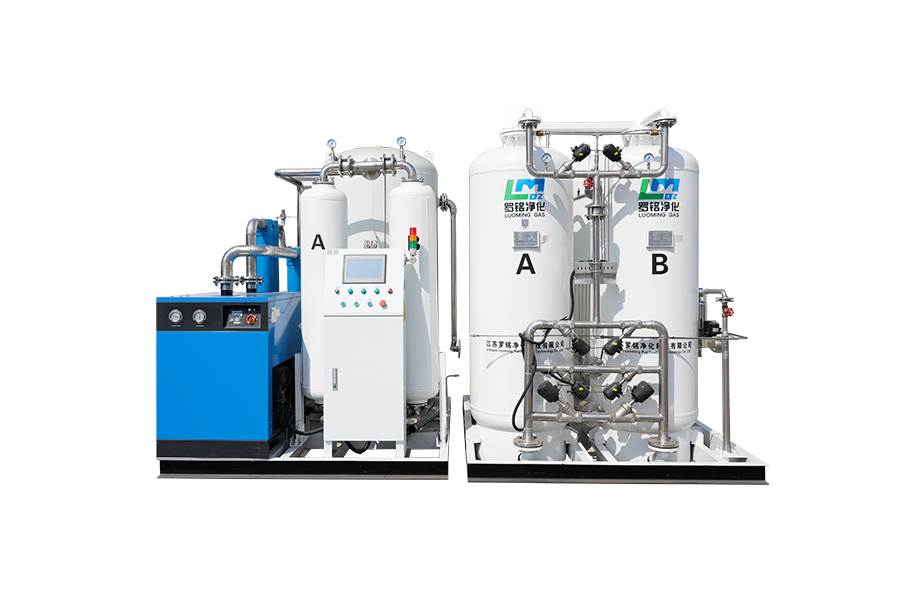
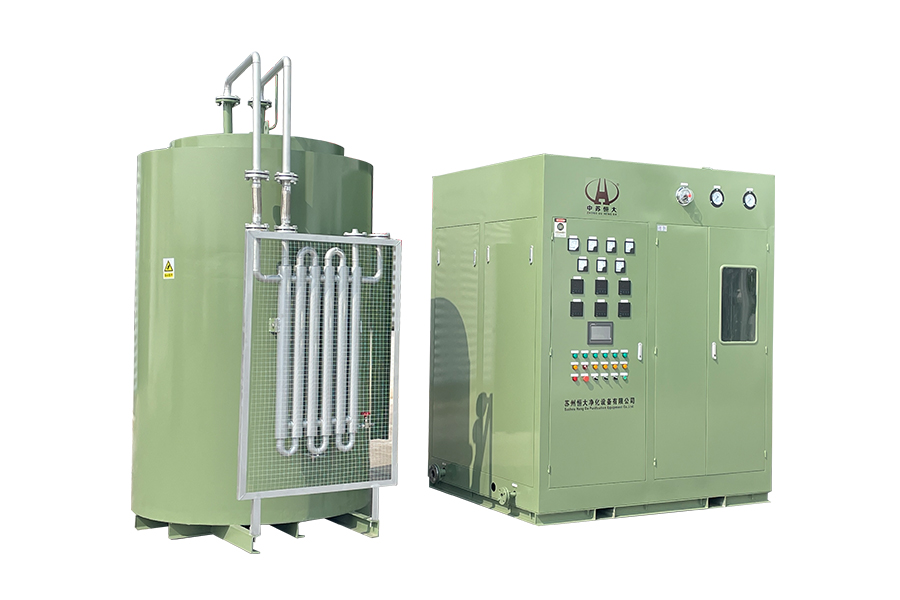
A tender line that reads 20 Nm3/h, 93 percent oxygen, 4 bar at the outlet, minus 40 degrees Celsius dew point and 150 bar for cylinder filling is not one requirement. It is four subsystems stacked into a single sentence, and the supplier who quotes it as one number is usually the one who ends up arguing about acceptance tests.
Buyers rarely get to see that split until commissioning, when the flow is right but the dew point is not, or the purity is right but the booster cannot reach filling pressure. Separating the specification into separation, conditioning, storage and boosting makes the commercial comparison honest again.
92-95% Standard two-bed PSA purity, measured at the buffer outlet
99.5% Reached only after catalytic or carbon purification
150 bar Usual cylinder filling pressure after the booster stage
What an Oxygen Generation System Actually Is
An oxygen generation system is a packaged plant that compresses ambient air, removes water, oil and carbon dioxide, separates oxygen from nitrogen through zeolite adsorption, membrane permeation or cryogenic distillation, and delivers the product at the flow, purity and pressure a process or a ward requires.
The separation vessel is only the visible part. Everything upstream of the sieve decides how well the sieve performs: moisture, oil carry-over and carbon dioxide all compete for adsorption sites, which is why the dryer train and the coalescing filters deserve the same engineering attention as the beds themselves. Typical packages include an intake filter, compressor, refrigerated dryer, filter train, twin adsorption vessels, a surge tank, an oxygen analyser and, where cylinders are involved, a booster.
Commercial oxygen separation routes compared on typical purity, practical scale and start-up behaviour.
| Route |
Typical purity |
Practical scale |
Cold start |
Where it fits |
| PSA with zeolite sieve |
90-95 percent |
3-200 Nm3/h |
15-40 minutes |
Hospitals, aquaculture, cutting, wastewater |
| PSA plus catalytic purification |
up to 99.5 percent |
5-80 Nm3/h |
30-60 minutes |
Filling stations, high purity medical duty |
| Membrane separation |
28-40 percent |
1-100 Nm3/h equivalent |
under 5 minutes |
Combustion assist, ozone feed, aeration |
| Cryogenic distillation |
99.6 percent and above |
500 Nm3/h and above |
8-24 hours |
Large metallurgical and chemical complexes |
Chemical generators, the kind stored in an aircraft overhead bin, sit outside this comparison. They release oxygen from a chlorate candle for a fixed number of minutes and cannot be cycled, restarted or scaled, so they solve an emergency problem rather than a supply problem.
Inside the PSA Cycle: Five Stages That Decide Output
Pressure swing adsorption separates oxygen by pushing compressed air through a zeolite molecular sieve bed that holds nitrogen preferentially and lets oxygen pass, then releasing the trapped nitrogen at low pressure so the bed can be reused.
Intake and compression
Ambient air is filtered and compressed to roughly 6 to 8 bar. Pressure is what makes adsorption selective, so a supply that sags under load shows up later as purity that sags with it.
Drying and filtration
A refrigerated dryer and coalescing filters strip water and oil aerosol before the sieve sees the air. Inlet dew point is the most reliable single predictor of sieve life.
Adsorption at pressure
Air rises through the online bed. Nitrogen is retained on the zeolite, oxygen passes through alongside argon, and product leaves the vessel in the 92 to 95 percent band.
Regeneration and purging
The bed is depressurised and a small slip stream of product oxygen sweeps the nitrogen out. Beds alternate every few tens of seconds, which is why output looks continuous even though each vessel works in batches.
Buffering, analysis and boosting
Product oxygen enters a surge tank, passes an analyser that governs the outlet valve, and is either piped at low pressure or boosted to storage or cylinder pressure.
A sieve that has been wetted does not recover with a service call. It has to be opened, emptied and refilled, so a stable inlet dew point is cheaper than any warranty conversation.
 LMO PSA Oxygen Generator for High-Purity Medical SupplyConsider this two-tower zeolite PSA oxygen plant when stable inlet dew point and sizing around purity, flow and pressure matter.View Product →
Sizing: The Numbers That Actually Decide the Project
Sizing an oxygen generation system comes down to six figures: peak flow, purity, delivery pressure, dew point, site altitude and how many consumers draw at the same moment.
- Peak flow, not average flow, sets the bed size
- Purity above 95 percent adds a purification stage, not a bigger sieve
- Delivery pressure decides whether a booster is inside or outside the package
- Dew point is a promise about the dryer, and it should be written as one
- Altitude changes air density and cuts available capacity
- Simultaneity factor stops you paying for capacity nobody opens at once
Two-bed PSA
Containerised PSA
Cryogenic plant
Delivered liquid
The chart above is not a ranking of quality. It shows why delivered liquid keeps winning short projects and why a cryogenic plant is never bought for a two-week campaign. Altitude matters just as much: at 3,500 metres a compressor moves far less mass per stroke, so a nameplate rating measured at sea level has to be corrected before it is quoted into a plateau oxygen supply project.
Ask for flow at site conditions, not at standard conditions. The gap between the two is where most of the post-award correspondence is written.
On-Site Generation Against Delivered Liquid and Cylinders
On-site generation is cheaper per cubic metre when consumption is high and steady, while delivered liquid and cylinders stay cheaper when demand is low, seasonal or contractually short.
Delivered gas
- No capital outlay up front
- Purity fixed by the supplier
- Cost rises with every cubic metre
- Exposure to transport, weather and tanker schedules
- Storage, refilling and site safety obligations remain yours
On-site generation
- Capital plus electricity, then a low marginal cost
- Purity fixed at commissioning and easy to verify
- Cost per cubic metre falls as volume rises
- Supply independent of delivery windows
- Requires maintenance discipline and trained operators
Steady industrial duty tends to justify the switch fastest. Processes such as wastewater treatment run around the clock, which is exactly the profile that makes a delivered-gas contract expensive over a five-year view.
The break-even point is not a purity question or a technology question. It is the annual cubic metre figure at which your delivered-gas invoice exceeds capital repayment plus power plus sieve amortisation.
Medical, Plateau and Industrial Duty Are Specified Differently
The same separation hardware is specified three different ways depending on whether it serves a ward, a high-altitude site or a furnace.
- Medical duty is defined by documentation as much as by purity: alarm logic, duplex compressors, a backup manifold and an analyser record that survives an audit.
- Industrial duty treats purity as a process variable. A cutting table tolerates a different band from a bright annealing furnace, and the specification should say which band applies at the point of use.
- High-altitude duty corrects for air density and often shifts the delivery method from piped ward outlets to dispersed outlets in rooms and corridors.
- Redundancy is a design decision, not an upgrade. N+1 compressor capacity and a buffer sized for peak ward demand matter more than a marginal purity gain.
 Medical PSA Molecular Sieve Oxygen Generator for HospitalsCheck this medical oxygen generator when ward supply, bed capacity and service continuity alongside compressor maintenance are the deciding factors.View Product →
In a hospital the real question is not whether the plant can make 93 percent oxygen, but whether it can keep doing so while the compressor beside it is being serviced.
Cost, Lead Time and the Questions Worth Asking
Most of an oxygen generation system's lifetime cost sits in electricity and sieve replacement, not in the purchase price, so the questions asked before the order are the ones that move the total.
- What inlet dew point is guaranteed, and who owns the dryer if it drifts?
- Which components are duplicated, and what output remains available during service?
- Is quoted purity measured at the vessel outlet or at the point of use?
- What is the sieve replacement interval, and is the refill priced today or later?
- How is capacity corrected for altitude, ambient temperature and power quality?
Request the acceptance test procedure with the quotation. A supplier who can describe how flow, purity and dew point will be proven at your site has usually built the package to survive that test.
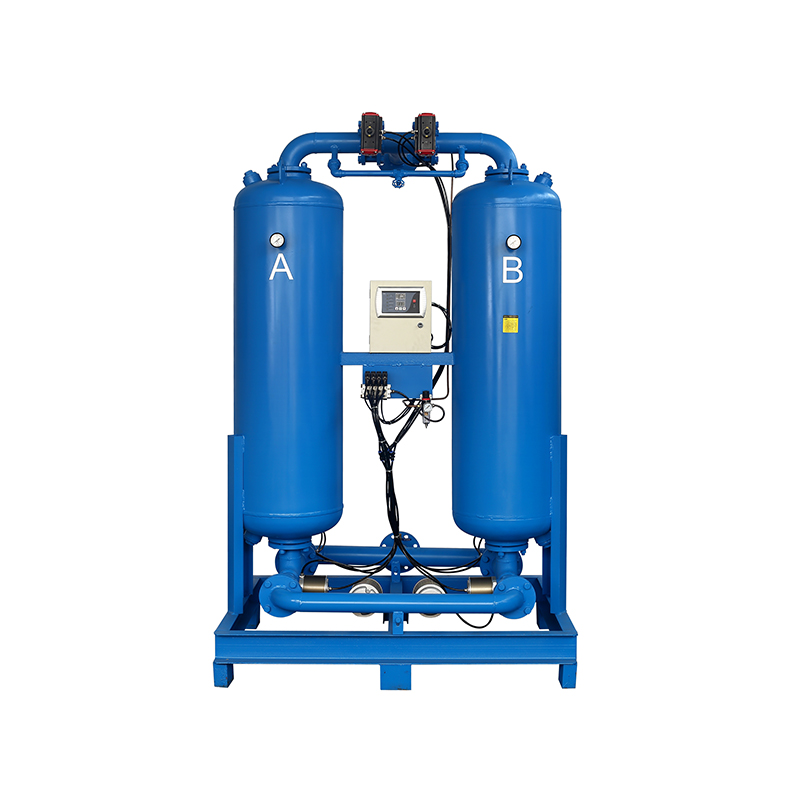 Oxygen Filling Station Solution for On-Site Cylinder SupplyReview this filling station solution for local cylinder supply and resale, where acceptance tests must prove outlet purity, site-condition flow and cold-start ramp.View Product →
Frequently Asked Questions
Three specifications decide most contracts: purity at the outlet, flow at site conditions, and the ramp time from cold start to specification gas.
How much oxygen can a PSA system produce?
Standard packages run from a few cubic metres per hour up to roughly 200 Nm3/h, and capacity scales through vessel size and modular trains rather than through a single larger sieve.
Is 99.5 percent purity always necessary?
No. Many medical regimes accept 92 to 95 percent from a validated molecular sieve plant, while 99.5 percent is specified for cylinder filling, certain laboratory work and some metallurgical processes.
What maintenance does the plant need?
Filter element changes, dryer service, analyser calibration and compressor maintenance are routine. Zeolite replacement usually falls in the five to ten year range and depends almost entirely on how well the inlet air was dried.
How much space does a system occupy?
A containerised unit needs a hardstanding, ventilation clearance and room for the buffer tank; skid-mounted plants need similar clearance indoors plus a route for vessel replacement.





 English
 русский
 Français
 Español
 عربى