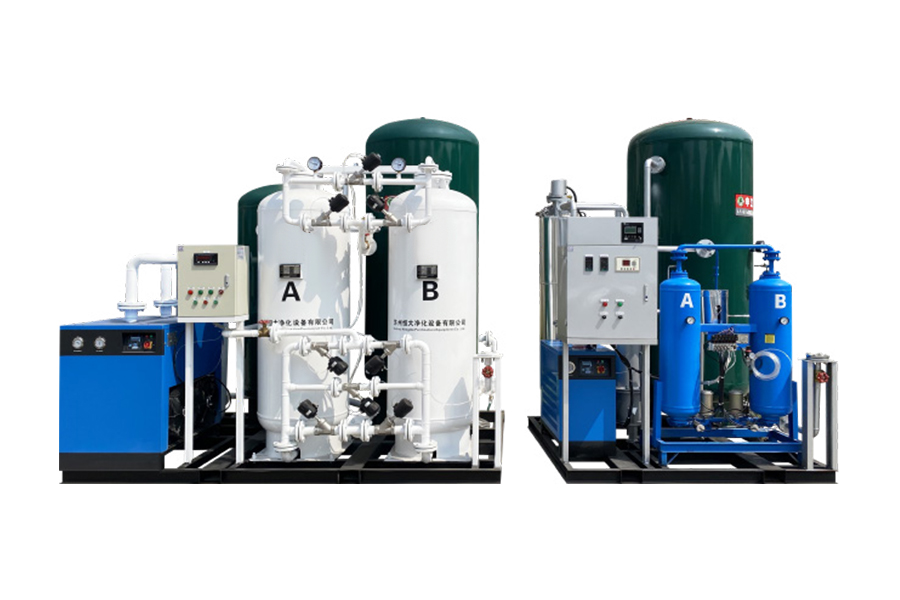
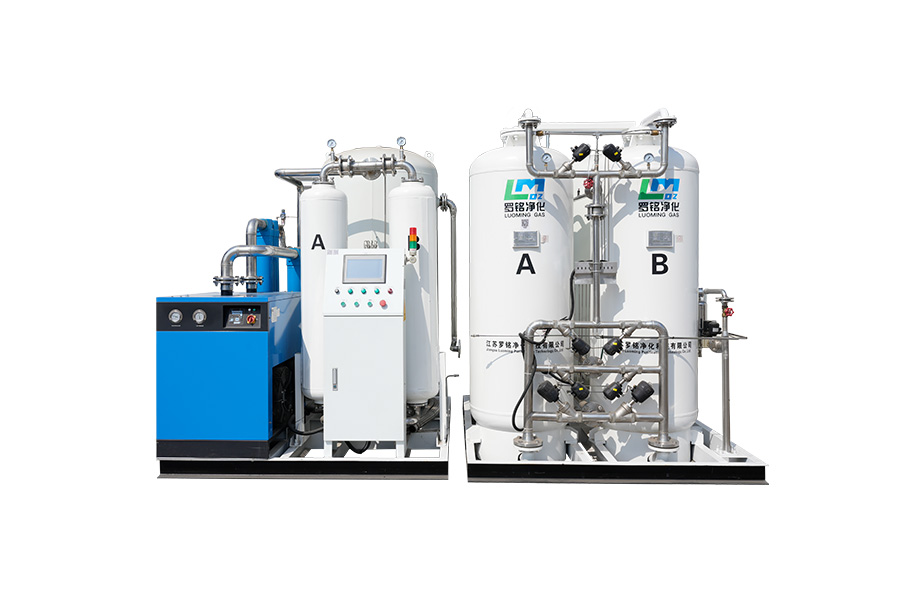
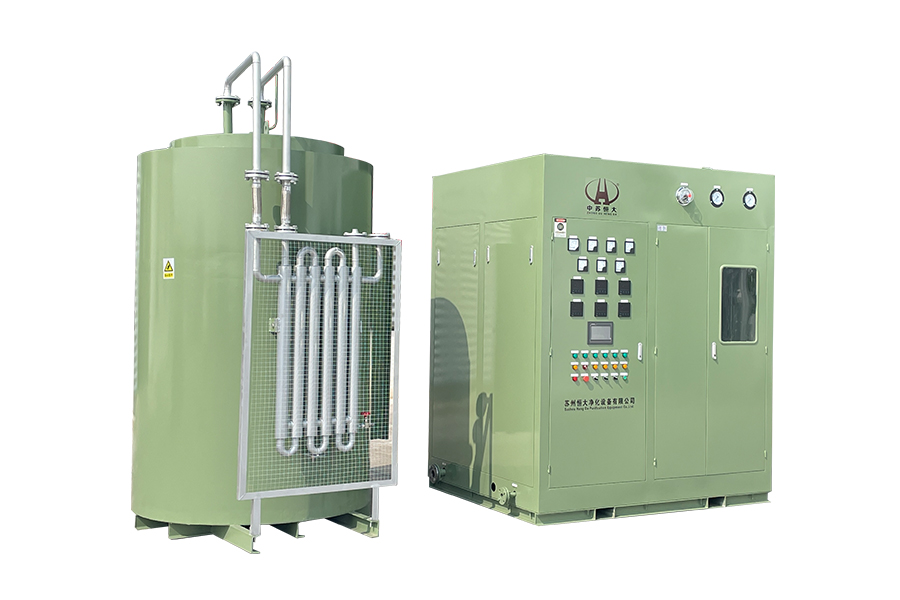
Every facility that relies on a steady oxygen supply faces the same hidden cost: dependence on cylinder deliveries, storage logistics, and price volatility from third-party suppliers. PSA oxygen generators for industrial use eliminate that dependency entirely, producing oxygen on demand from ambient air. This guide covers the essentials — how the technology works, what specs matter, and how to choose the right system for your operation.
How PSA Oxygen Generators Work
Pressure Swing Adsorption (PSA) is the technology behind most modern oxygen generation systems. Ambient air — roughly 21% oxygen and 78% nitrogen — is compressed and fed through vessels packed with zeolite molecular sieve. Zeolite has a strong affinity for nitrogen: under pressure, it traps nitrogen molecules and lets oxygen pass through, concentrating it in the output stream.
Most systems run two adsorption towers in alternating cycles. While one tower is producing oxygen, the other is venting the captured nitrogen and regenerating the sieve material. A PLC controller manages the switching automatically, delivering a continuous, uninterrupted oxygen stream without operator input. Output purity typically reaches 93% ±2% in standard configurations, with high-purity variants achieving 99.5% using an additional purification stage.
There are no cryogenic liquids involved and no high-pressure cylinder hazards on-site. The only consumable is electricity, and the zeolite sieve — when maintained properly — lasts the operational lifetime of the unit.
Key Specs to Evaluate Before Buying
Three parameters define whether a given oxygen generator actually fits your process. Getting any one of them wrong means either underperforming equipment or paying for capacity you'll never use.
- Flow rate (Nm³/h): Calculate your peak consumption, not your average. A hospital ward, a fish farm aeration system, and a metal-cutting line each have distinct demand profiles. Undersizing the flow rate creates supply gaps during peak demand.
- Purity (%): Medical oxygen requires a minimum of 93% (pharmacopoeia grade). Industrial cutting and welding applications typically operate well at 90–95%. Certain chemical processes demand 99.5% or above. Match purity to the actual requirement — higher purity means higher operating cost.
- Discharge pressure (Bar): Standard PSA output runs at 3–5 Bar. Applications that need cylinder-level pressures (150–200 Bar) require an integrated oxygen booster compressor downstream of the generator.
When requesting a quote, provide all three values — flow rate, purity, and discharge pressure — along with your local voltage and frequency. A properly specified system can be sized and configured before manufacturing begins, avoiding costly field modifications later.
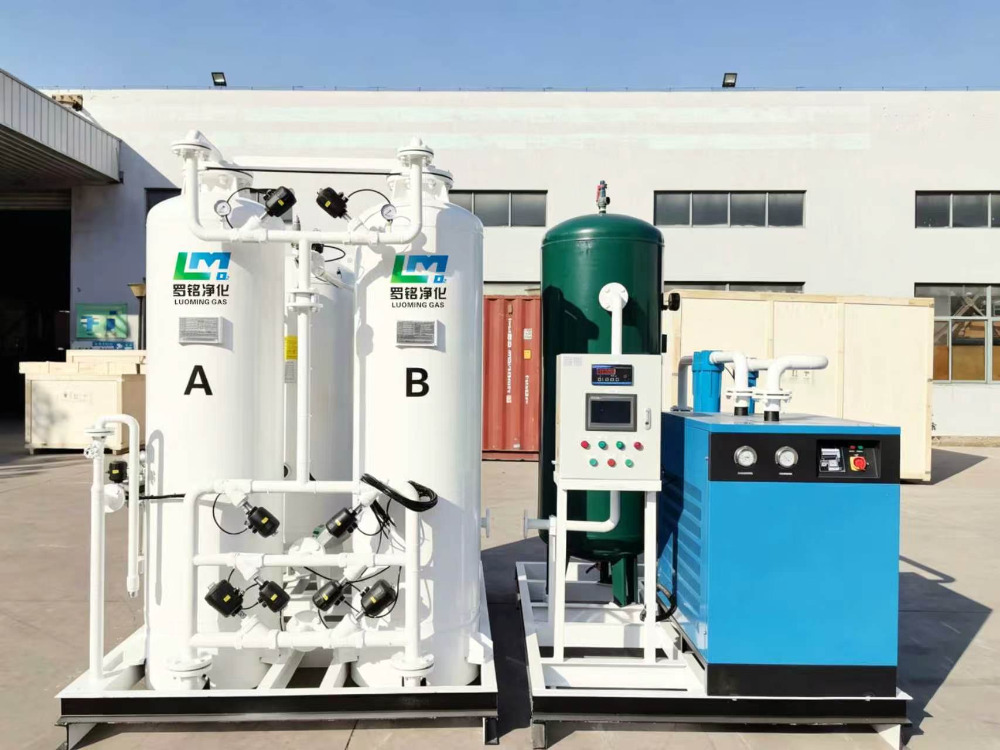
Industrial Applications Across Sectors
Oxygen generation systems are genuinely cross-industry infrastructure. The same PSA principle scales from a small clinic to a large metallurgical plant.
In healthcare, medical oxygen generation systems supply pipeline oxygen to ICUs, operating theaters, and nursing homes around the clock. The World Health Organization recognizes oxygen as an essential medicine, yet less than half of hospitals in low- and middle-income countries have uninterrupted access to it. An on-site PSA system resolves this directly.
Beyond healthcare, oxygen generation applications in aquaculture and wastewater treatment are among the fastest-growing segments. Dissolved oxygen levels directly govern fish survival rates in intensive aquaculture, and biological wastewater treatment processes require sustained oxygen injection to support aerobic bacteria. Other established industrial uses include:
- Metal cutting and flame welding (oxygen-enriched flame increases cutting speed and reduces gas consumption)
- Metallurgical furnaces (oxygen injection improves combustion efficiency and reduces fuel costs)
- Ozone generation for water treatment and food processing
- High-altitude oxygen supply for mining sites, plateau construction, and mountain resorts
- Stone and glass processing requiring controlled combustion environments
On-Site Generation vs. Traditional Oxygen Supply
The economic case for on-site generation is straightforward. Cylinder oxygen comes with recurring delivery fees, rental charges, hazmat handling costs, and exposure to market price fluctuations. Liquid oxygen requires cryogenic storage tanks, evaporation losses during storage, and the same delivery dependency.
PSA oxygen generators convert these variable costs into a fixed capital investment with a predictable electricity expense. Energy consumption as low as 0.55 kW per Nm³ is achievable with modern systems. For facilities consuming more than 10 Nm³/h continuously, the payback period on a generator is typically under three years — after which the oxygen is essentially free beyond power costs.
Supply method comparison for continuous industrial oxygen use
| Factor |
Cylinder / Liquid O₂ |
On-Site PSA Generator |
| Supply continuity |
Dependent on delivery schedule |
24/7, fully automatic |
| Long-term cost |
High (recurring) |
Low (power only after capex) |
| Storage hazard |
High-pressure / cryogenic |
Minimal |
| Scalability |
Limited by delivery capacity |
Modular, expandable |
| Purity range |
Fixed (cylinder grade) |
Adjustable 90–99.5% |
What to Look for in a Supplier
The generator itself is only part of the equation. A system that runs reliably for ten or fifteen years depends on how it was designed, built, and supported.
Start with certifications. For medical applications, ISO 13485 and CE marking are non-negotiable. ISO 9001 covers quality management across industrial systems. Suppliers who hold both medical and industrial certifications can serve a wider range of purity and pressure requirements, and their quality control processes are independently verified.
Customization capability matters more than catalog specifications. Real installations involve specific voltages, unusual ambient temperatures, containerized deployments, or combined oxygen-and-filling-station requirements. A supplier who only sells standard skid-mounted units will struggle to serve remote or demanding environments. Look for evidence of engineering depth: teams capable of designing containerized mobile units, high-altitude variants, or integrated filling systems.
Finally, consider after-sales support structure. What happens when a pneumatic valve fails at 2 a.m. in a facility that cannot interrupt oxygen supply? A supplier with remote diagnostic capability, documented spare parts availability, and trained field engineers in your region is worth considerably more than one that ships a box and disappears. Ask specifically about molecular sieve replacement schedules, PLC remote access, and response time commitments before signing.
For operations that require flexibility in form factor — field deployment, disaster response, or mobile applications — portable oxygen generator options extend the same PSA technology into trailer-mounted or containerized configurations that can be relocated as operational needs change.





 English
 русский
 Français
 Español
 عربى
عربى