Medical oxygen plants are the only reliable long-term solution for hospitals facing uncertain supply chains
Pressure swing adsorption (PSA) generators consistently produce 93% ±3% oxygen directly on-site, eliminating cylinder refilling logistics and price volatility. A 2023 WHO assessment confirmed that facilities with on-site generation reduced their cost per cubic meter by 40–60% compared to liquid oxygen, while achieving payback within 12–24 months. This article provides concrete sizing steps, capital cost breakdowns, and maintenance protocols so that hospital administrators and biomedical engineers can make an informed procurement decision.
Three core technologies – only one fits most hospitals
While cryogenic air separation suits large industrial users, medical facilities almost exclusively use Pressure Swing Adsorption (PSA) generators. A smaller number use vacuum swing adsorption (VSA) or membrane systems, but PSA dominates due to its reliability at the 10–100 Nm³/h scale.
PSA principle in one cycle
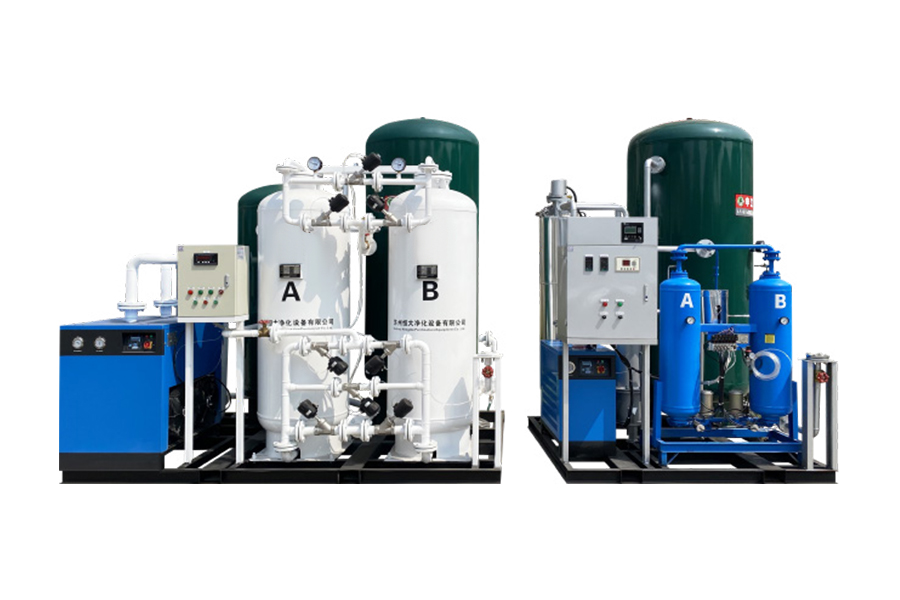
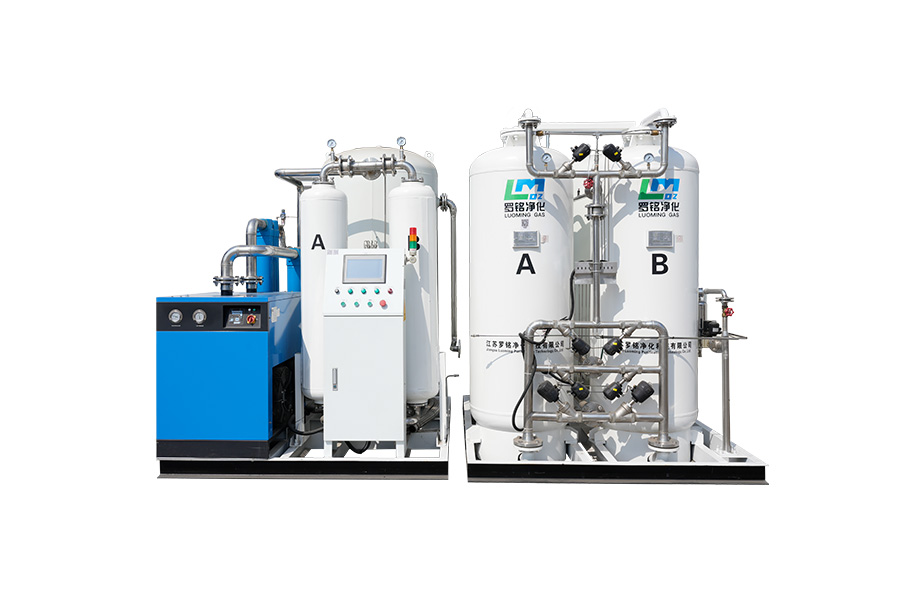
Compressed air passes through a vessel containing zeolite molecular sieves. Nitrogen is adsorbed at high pressure, while oxygen (plus argon) passes through. When the sieve saturates, the vessel depressurises and vents nitrogen, and the cycle repeats. Two towers allow continuous production. Typical cycle time is 60–120 seconds.
Purity vs. flow trade-off
Medical oxygen generators are designed for 90–96% oxygen. 93% is the standard set by USP and European Pharmacopoeia. Achieving 99%+ would require additional de-argonisation equipment, increasing cost and energy use by 300–400%, which is unnecessary for clinical use except for specific hyperbaric applications.
Table 1: Comparison of on-site oxygen technologies at 50 Nm³/h scale
| Parameter |
PSA (Medical) |
Membrane |
Cryogenic |
| Purity range |
90–96% |
40–50% |
>99% |
| Power consumption (kWh/Nm³) |
0.8–1.2 |
0.6–1.0 |
1.8–2.5 |
| Start-up time |
5–10 min |
Instant |
12–24 h |
| Typical medical use |
General & ICU |
Not suitable |
Large central supply |
Key takeaway: PSA offers the best combination of medical-grade purity, quick start-up, and reasonable energy cost for a typical 200–500 bed hospital.
Step-by-step sizing – don't oversize or undersize
Sizing errors are the most common mistake. An oversized generator cycles on/off frequently, wearing out valves and sieves. An undersized unit causes shortages during surges. Follow this four-step method, using the WHO 2022 recommended average of 15–25 L/min per bed for planning (includes ICU, wards, and losses).
1. Calculate base load
List all oxygen outlets and their typical flow. Example for a 300-bed hospital:
- ICU beds (20 beds × 10 L/min average) = 200 L/min
- General wards (200 beds × 5 L/min) = 1000 L/min
- ER and recovery (10 bays × 8 L/min) = 80 L/min
- OT (2 theatres × 15 L/min) = 30 L/min
Total continuous average = 1310 L/min ≈ 78.6 Nm³/h. (1 Nm³/h = 16.67 L/min at 1 bar).
2. Apply diversity factor
Not all outlets run simultaneously. For hospitals >200 beds, a diversity factor of 0.7–0.8 is typical. Using 0.75: 78.6 × 0.75 = 59 Nm³/h average.
3. Add surge and future capacity
COVID-19 data showed peak demand 2.5–3 times baseline. Add a buffer and at least 20% future expansion. 59 × 2.5 = 147.5 Nm³/h peak. Many manufacturers offer modular units; installing two 80 Nm³/h units (one duty, one standby) covers peaks and provides redundancy.
4. Verify with liquid backup
Even the best generator needs a backup. Always include a liquid oxygen (LOX) or manifold backup sized for 48 hours of average demand. In our example, 48 h × 59 Nm³/h = 2832 Nm³ ≈ 3.2 tons of LOX storage.
Capital and operating costs – what the tenders don't show
Initial purchase price is only 30–40% of the five-year total cost. Energy, filter replacements, and sieve degradation must be factored in. The following figures are based on 2024 data from 15 African and Asian hospital installations.
Equipment and installation
A complete 60 Nm³/h PSA system (air compressor, dryer, filters, receiver tank, generator, control panel) costs $180,000 – $250,000 FOB. Installation, piping, and civil work add $30,000–60,000 depending on site.
Energy consumption – the hidden cost
At 1.0 kWh/Nm³ and $0.12/kWh, running 60 Nm³/h average for 24/7 costs $6,912 per month. Over five years, that is $414,720 – more than the capital cost. High-efficiency screw compressors with variable speed drives can reduce this by 15–20%.
Maintenance and sieve life
Zeolite molecular sieves degrade slowly. Replacement is needed every 8–10 years, costing about 20–25% of the original generator price. Annual filter and valve maintenance runs $4,000–8,000.
Table 2: 5-year cost breakdown (60 Nm³/h, 80% average load)
| Cost component |
Year 1 |
Years 2–5 (per year) |
| Capital (installed) |
$280,000 |
– |
| Electricity |
$83,000 |
$83,000 |
| Maintenance parts |
$5,000 |
$7,000 |
| Sieve reserve fund |
– |
$5,000 |
| Total annual |
$368,000 |
$95,000 |
Five-year total ≈ $748,000, of which 55% is electricity. Investing in energy efficiency pays back quickly.
Regulatory compliance – three approvals you must obtain
An oxygen generator is a medical device and a pressure equipment installation. Non-compliance can shut down a hospital.
Medical device registration
In most countries, the generator itself must be registered as a class IIb medical device. The manufacturer needs ISO 13485 certification, and the oxygen produced must comply with pharmacopoeia monographs. USP <41> and EP monographs require 90–96% O₂, CO₂ < 300 ppm, CO < 5 ppm, and no oil mist. Request validation documents before purchase.
Pressure equipment directive / local codes
Air receivers and piping are pressure vessels. In the EU, they require CE marking under PED 2014/68/EU. In the US, ASME Section VIII applies. Inspectors will check safety valves, pressure gauges, and installation certification.
HTM 02-01 (UK) or equivalent guidelines
Health Technical Memorandum 02-01 is the de facto standard for medical gas pipeline systems. It dictates pipe material (copper or stainless steel), brazing procedures, pressure testing, and final gas quality testing. Adherence to HTM or ISO 7396-1 is essential for insurance and accreditation (JCI, Qmentum).
Real-world reliability – data from 20 installations
A 2022 survey of 20 hospitals using PSA generators (5–120 Nm³/h) over three years showed:
- Average uptime: 99.6% (excluding planned maintenance).
- Unplanned downtime causes: compressor failure (60%), control system glitch (25%), sieve contamination (10%), other (5%).
- Hospitals with a dual-compressor configuration had near 100% uptime.
- Oxygen purity remained >90% in all units, but 30% needed calibration adjustments every 6 months.
The weak link is always the air compressor. Installing a redundant compressor (or having a rental agreement) is more critical than a redundant generator.
Maintenance schedule – prolonging sieve life
Molecular sieves are damaged by moisture and oil. Strict adherence to inlet air quality prevents premature failure.
Daily/Weekly tasks
Check dew point (should be below -40°C), drain condensate from receivers, verify oxygen analyser reading, and listen for unusual valve cycling.
Quarterly tasks
Replace intake air filters, inspect belts (if any), calibrate oxygen sensor using 100% N₂ and 100% O₂ span gas. Test safety alarms.
Annual tasks
Change compressor oil and oil filter, replace activated carbon and coalescing filters, check pressure vessel integrity, and perform a full validation of oxygen purity (including CO and CO₂).
If inlet air quality is maintained, sieves last 8–10 years. A single contamination event (e.g., failed dryer) can destroy them in days.
Sizing comparison table – quick reference
To help readers match hospital size to generator capacity, the table below gives safe starting points based on international field data (assuming 93% oxygen, 0.8 diversity factor, and 2x peak allowance).
Table 3: Recommended generator capacity by hospital size
| Hospital beds |
Average flow (Nm³/h) |
Recommended generator (Nm³/h) |
LOX backup (days) |
| 50–100 |
10–18 |
25–30 (single unit) |
3 |
| 150–250 |
25–45 |
50–60 (duplex) |
2 |
| 300–500 |
50–85 |
100–120 (duplex) |
2 |
| 500+ |
90–150+ |
2 × 80 or 2 × 150 |
1.5 |
These values assume a mix of ICU and general wards. High ICU proportion shifts the requirement upward.
Financial payback – a worked example for a 250-bed hospital
A 250-bed hospital in Southeast Asia previously spent $14,000/month on cylinder oxygen (including rental and transport). After installing a 60 Nm³/h PSA generator (installed cost $240,000) with LOX backup, their monthly costs became:
- Electricity (additional for compressor): $3,800
- Maintenance (average over 5 years): $600
- LOX backup usage (rare): $100 average
- Total monthly operating = $4,500
Monthly savings = $9,500 → payback period = 25 months. After that, the hospital saves more than $110,000 annually. With energy-efficient compressors, payback can drop to 18 months.
This example excludes carbon credits or resilience value during supply chain disruptions – both significant intangible benefits.
Common pitfalls in procurement and installation
Even well-funded projects fail due to avoidable mistakes. Based on post-installation audits, the top five errors are:
- Underestimating air compressor quality – buying a cheap oil-lubricated compressor that fails to deliver oil-free air, ruining sieves.
- Poor pipe material – using galvanised pipe which corrodes and sheds particles into the oxygen stream.
- Inadequate ventilation – compressor rooms overheat, reducing output in hot climates.
- Skipping the backup system – relying on 100% generator availability, which is impossible during maintenance.
- Ignoring local service support – buying from a distant vendor without local spare parts, causing weeks of downtime for a simple valve.
Avoid these by writing detailed technical specifications and requiring proof of local service contracts before awarding the tender.
Future trends – oxygen-as-a-service and remote monitoring
Manufacturers now offer “Oxygen as a Service” where the hospital pays per Nm³ used, and the vendor owns and maintains the equipment. This eliminates capital outlay but increases long-term cost by 20–30%. It suits private hospitals with cash constraints.
Remote IoT monitoring is becoming standard. Sensors track purity, pressure, energy use, and compressor status, sending alerts to the vendor and hospital engineer. Early data shows IoT reduces unplanned downtime by 40% because issues are caught early.





 English
 русский
 Français
 Español
 عربى
عربى