Why Inert Gas Protection Has Become Non-Negotiable in Chemical Facilities
Chemical processing environments are inherently volatile. The presence of flammable solvents, reactive intermediates, and combustible dust means that even a momentary oxygen intrusion into a sealed vessel, pipeline, or storage tank can trigger catastrophic consequences. Traditional fire suppression and explosion prevention methods — ventilation controls, grounding systems, spark-proof equipment — address ignition sources, but they do not eliminate the oxidizer itself.
Inert gas blanketing addresses the problem at its root. By displacing oxygen with an inert medium — typically nitrogen — below the threshold required to sustain combustion (generally below 8% O₂ by volume for most hydrocarbon environments), facilities can render explosive atmospheres chemically inert regardless of the ignition risk. This approach is increasingly codified in international standards such as ATEX, IECEx, and NFPA 69, which now explicitly recognize continuous inerting as a primary explosion prevention method rather than a supplementary measure.
The evolution from periodic nitrogen cylinder deliveries to on-site continuous generation marks a structural shift in how chemical plants approach this challenge — and PSA nitrogen generators sit at the center of that transition.
How PSA Technology Delivers Continuous, High-Purity Nitrogen On Demand
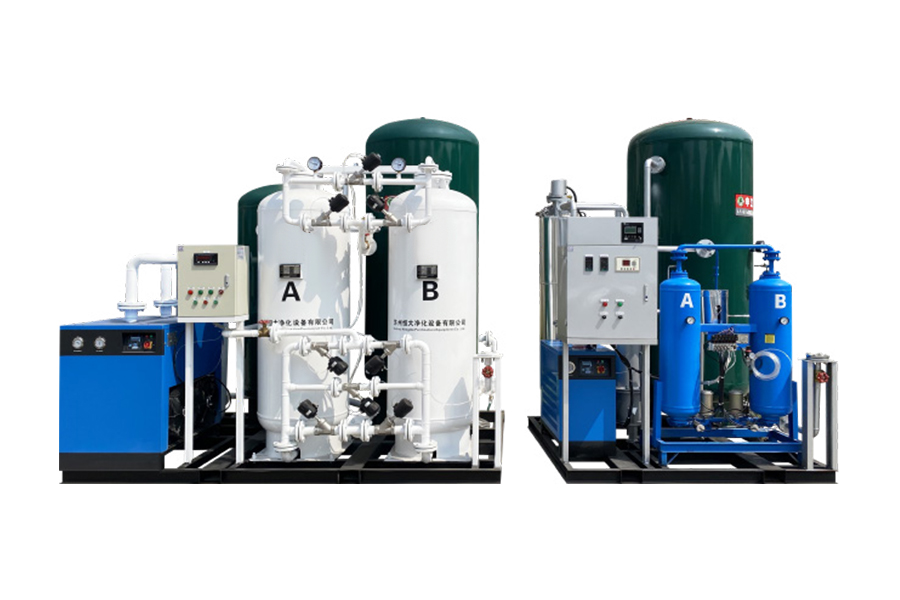
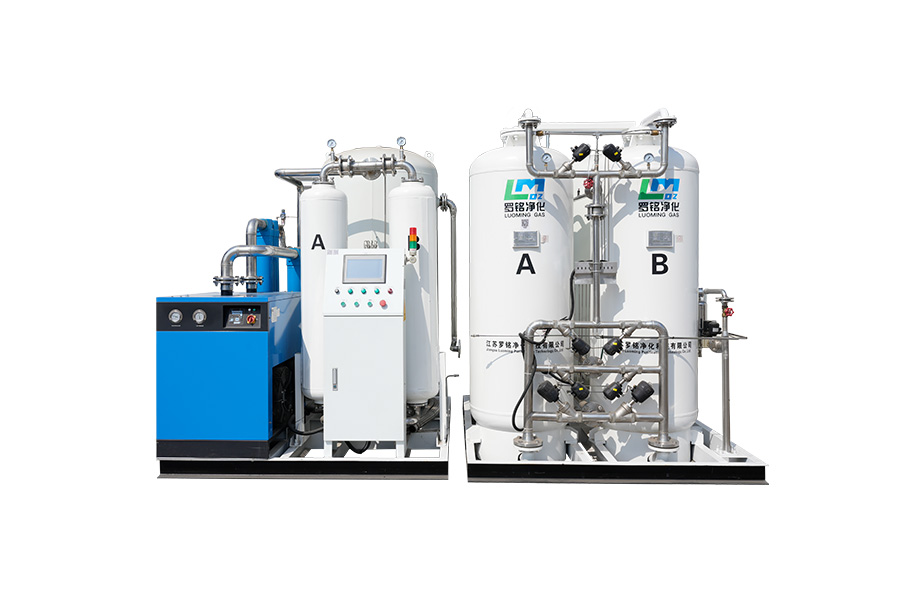
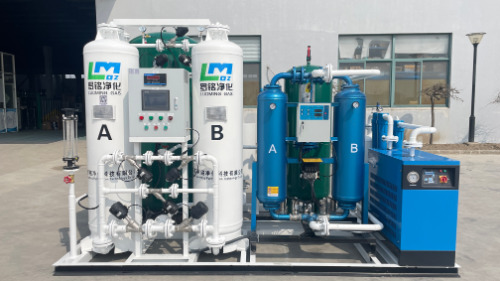
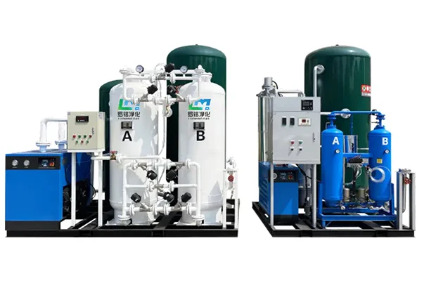
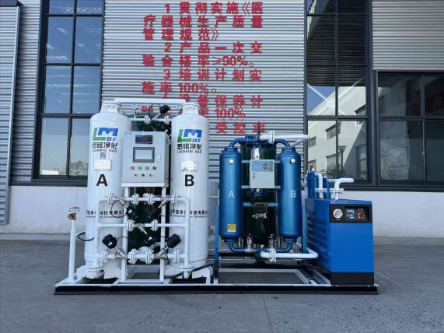
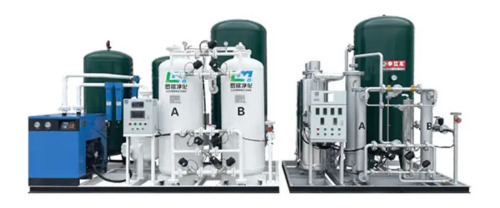
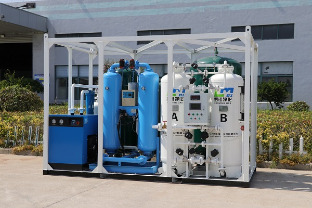
Pressure Swing Adsorption (PSA) is a gas separation process that exploits the differential adsorption affinity of materials — most commonly carbon molecular sieve (CMS) — for oxygen and nitrogen molecules under varying pressure conditions. In a typical dual-tower PSA system:
- Compressed air enters Tower A under elevated pressure; oxygen, carbon dioxide, and water vapor are selectively adsorbed by the CMS bed.
- High-purity nitrogen passes through and is collected in a buffer tank for delivery to the process.
- While Tower A is producing, Tower B undergoes regeneration at near-atmospheric pressure, releasing adsorbed gases and restoring adsorption capacity.
- The towers cycle continuously — typically every 60–120 seconds — ensuring an uninterrupted nitrogen stream.
Modern PSA systems designed for chemical explosion-proof zones are engineered to deliver nitrogen purity ranging from 99.0% to 99.999%, with flow rates scalable from a few Nm³/h for small reactors to thousands of Nm³/h for refinery-scale purge and blanketing systems. Crucially, the purity level is adjustable in real time — allowing operators to dial down to 99.5% for general purging applications or increase to 99.99%+ for oxygen-sensitive catalyst protection, without halting production.
| Application Scenario |
Required N₂ Purity |
Typical Flow Range |
| Storage tank blanketing |
99.0% – 99.5% |
10 – 500 Nm³/h |
| Reactor inerting & purging |
99.5% – 99.9% |
50 – 2,000 Nm³/h |
| Catalyst protection |
99.99% – 99.999% |
5 – 200 Nm³/h |
| Pipeline purging & commissioning |
99.0% – 99.5% |
100 – 5,000 Nm³/h |
Table 1. Typical PSA nitrogen purity and flow requirements by application scenario in chemical explosion-proof zones.
Application Practice: Deploying PSA Nitrogen Generators in Zone 1 and Zone 2 Classified Areas
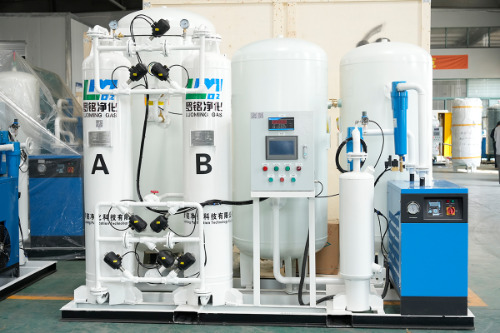
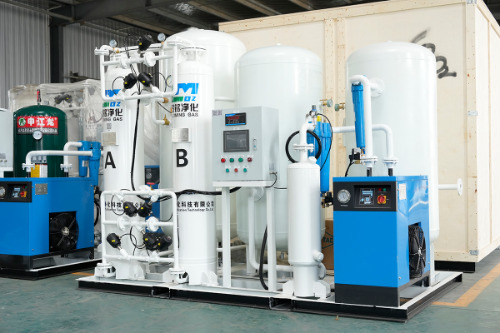
Integrating a PSA nitrogen generator into a hazardous area classified as ATEX Zone 1 or Zone 2 (or NEC Class I, Division 1/2 in North American frameworks) involves more than selecting a technically suitable machine. The deployment must satisfy both the process engineering requirements and the area classification constraints simultaneously.
Equipment Siting Strategy
In most installations, the PSA generator itself is positioned outside the hazardous zone — in a safe area or within a pressurized enclosure — with only the nitrogen delivery pipework entering the classified area. This arrangement eliminates the need to certify the entire generator skid for explosion-proof service, reducing capital cost and simplifying maintenance access. Where site constraints make remote siting impractical, Ex-rated enclosures (Ex d, Ex p, or Ex e depending on the component category) are used to protect electrical components such as control panels, solenoid valves, and sensors.
Continuous Oxygen Monitoring as a Safety Interlock
A PSA nitrogen generator operating in or near a chemical explosion-proof zone must be integrated with a real-time oxygen analyzer — both at the generator outlet and at critical delivery points within the process. If outlet purity drops below the setpoint (e.g., due to CMS degradation, compressor fault, or abnormal demand spike), an automatic diversion valve redirects off-spec nitrogen to vent rather than allowing it to enter the protected zone. This oxygen purity interlock is a mandatory feature in any safety-instrumented system (SIS) architecture compliant with IEC 61511.
Demand-Responsive Flow Control
Chemical processes are rarely steady-state. Batch reactors load and unload; storage tanks breathe with temperature and product level changes; purge sequences consume large volumes in short bursts. PSA systems designed for these environments incorporate variable-frequency drives (VFDs) on the air compressor, combined with buffer tank sizing calculated to absorb peak demand without purity excursions. The result is a system that responds dynamically to process demand while maintaining a constant positive pressure nitrogen blanket — a fundamental requirement for preventing air ingress during depressurization events.
Operational Economics: Why On-Site PSA Generation Redefines the Cost of Safety
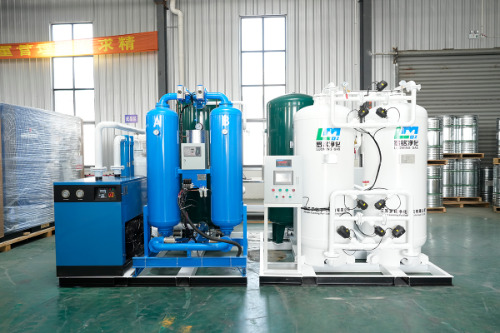
Historically, chemical facilities sourced nitrogen from bulk liquid deliveries or high-pressure cylinder manifolds — a model that introduces both supply chain risk and significant lifecycle cost. A facility consuming 500 Nm³/h of nitrogen continuously will, over a five-year period, spend substantially more on delivered gas than on the capital and operating cost of an equivalent PSA system. Independent lifecycle analyses consistently show payback periods of 18–36 months for medium-to-large chemical plants switching from delivered nitrogen to on-site PSA generation, with ongoing savings of 40–70% on nitrogen costs thereafter.
Beyond direct cost, on-site generation eliminates the safety and logistics risks associated with bulk liquid nitrogen storage — including cryogenic burn hazards, pressure relief events, and delivery schedule dependencies that can force production shutdowns. For explosion-proof zone applications where nitrogen availability is a safety-critical utility rather than an optional process input, this supply resilience is arguably more valuable than the cost savings alone.
Modern PSA units also feature remote monitoring capabilities — transmitting purity, flow, pressure, and equipment health data to plant DCS or SCADA systems — enabling predictive maintenance and reducing unplanned downtime. CMS bed life, typically 5–10 years under proper operating conditions, can be extended further through inlet air filtration and moisture control, making PSA nitrogen generators among the lowest-maintenance utilities in a chemical plant's asset portfolio.
Setting the New Benchmark: What Best-in-Class PSA Nitrogen Protection Looks Like
The convergence of tighter regulatory standards, rising insurance requirements for explosion-proof chemical facilities, and the demonstrated reliability of modern PSA technology has effectively established a new baseline for inert gas protection. Facilities that still rely on periodic nitrogen purges, manual cylinder changeouts, or undersized blanketing systems are increasingly out of compliance — not only with external standards but with the internal risk tolerance frameworks of insurers and corporate EHS functions.
What distinguishes a best-in-class PSA nitrogen protection system for chemical explosion-proof zones today includes:
- Continuous, uninterrupted nitrogen supply with zero dependence on external logistics
- Automatic purity verification and diversion interlocked with the SIS
- ATEX/IECEx-rated electrical components for all equipment within classified zones
- Demand-responsive flow management to handle batch and transient process conditions
- Full integration with plant DCS/SCADA for remote monitoring, alarming, and audit trails
- Documented compliance with NFPA 69, EN 1825, or applicable regional explosion prevention standards
As chemical facilities face increasing pressure to demonstrate proactive explosion risk management — from regulatory bodies, insurers, and increasingly from downstream customers conducting supply chain audits — PSA nitrogen generators have moved from a cost-optimization tool to a core element of process safety infrastructure. The benchmark has shifted: continuous on-site inert gas protection is no longer the premium option. It is the expected standard.





 English
 русский
 Français
 Español
 عربى
عربى