Choosing the right nitrogen generator is one of the most consequential decisions an industrial facility manager or procurement engineer will make. The wrong choice leads to wasted energy, inadequate purity, or unnecessary capital expenditure. The two dominant on-site nitrogen generation technologies — Pressure Swing Adsorption (PSA) and Membrane — both extract nitrogen directly from compressed air, but they differ fundamentally in how they work, what purity levels they achieve, and which applications they serve best.
This guide breaks down each technology in clear technical terms, compares them across every key performance dimension, and gives you a practical framework to make the right call for your operation.
What Are PSA and Membrane Nitrogen Generators?
Both PSA and membrane nitrogen generators share the same starting point: compressed atmospheric air, which is composed of approximately 78% nitrogen, 21% oxygen, and trace amounts of other gases. The goal of both technologies is to separate that nitrogen from everything else and deliver it at a controlled purity and flow rate — on demand, on-site, without relying on delivered cylinders or liquid nitrogen tanks.
On-site nitrogen generation typically reduces long-term gas supply costs by 40 to 70 percent compared to cylinder or bulk delivery methods, according to industry data. Beyond cost, both systems eliminate supply chain dependency and give operators direct control over purity, pressure, and volume. The critical difference lies in the separation mechanism each technology uses — and that mechanism determines everything downstream, from achievable purity to maintenance requirements to total cost of ownership.
How Does Each Technology Work?
PSA Nitrogen Generators
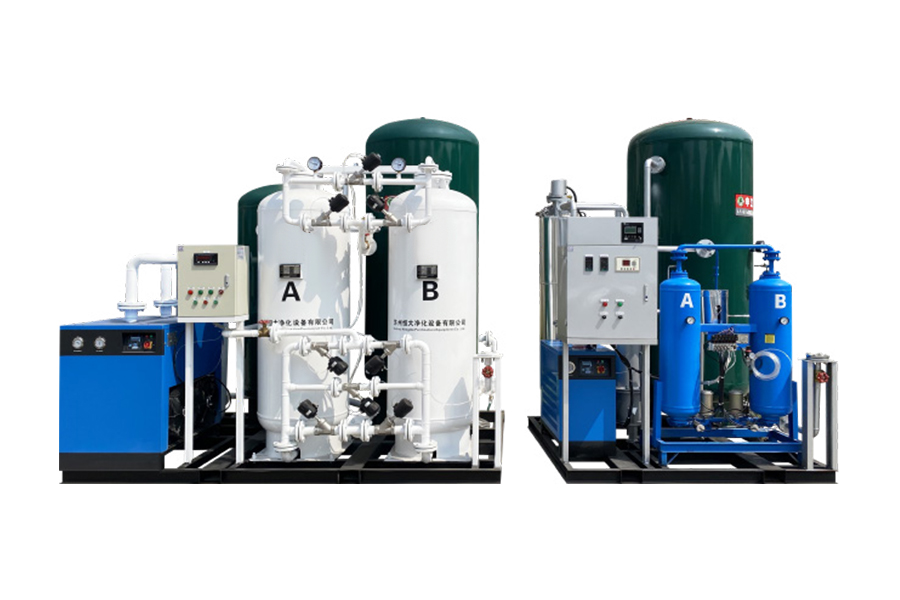
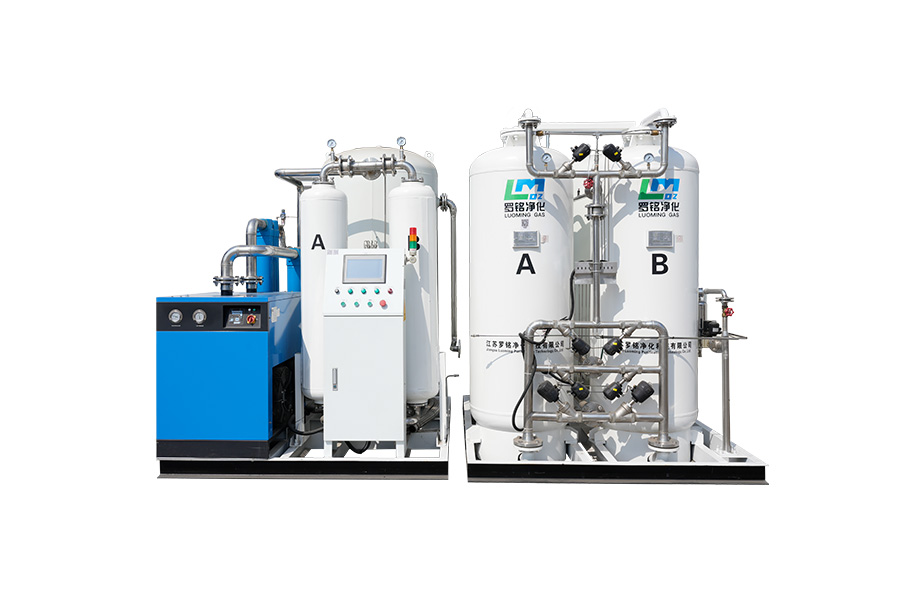
PSA nitrogen generators rely on the principle of selective adsorption. Compressed air is passed through vessels filled with Carbon Molecular Sieve (CMS) — a material engineered with precisely uniform micropores that preferentially trap oxygen, carbon dioxide, and water vapor while allowing nitrogen molecules to pass through freely. The nitrogen that bypasses the CMS is collected as the product gas.
Because the CMS eventually becomes saturated with adsorbed oxygen, a PSA system contains two parallel CMS vessels that alternate automatically. While one vessel adsorbs impurities under pressure, the other depressurizes and regenerates by flushing out the trapped oxygen as waste gas. This switching cycle, typically controlled by a programmable logic controller (PLC), repeats every 30 to 120 seconds and ensures uninterrupted nitrogen output. The entire process is automated, with integrated sensors continuously monitoring pressure, flow rate, and purity.
Membrane Nitrogen Generators
Membrane nitrogen generators use a fundamentally different physical principle: differential permeation. Compressed air is pushed through bundles of hollow polymer fiber membranes. The key insight is that oxygen molecules, water vapor, and carbon dioxide permeate through the fiber walls significantly faster than nitrogen. As a result, the faster-permeating gases exit through the membrane wall as waste (called permeate), while the slower-moving nitrogen accumulates and exits the other end as the enriched product stream.
Membrane systems have no moving parts in the separation stage itself. There are no switching valves or PLC-controlled adsorption cycles — just compressed air flowing continuously through the fiber bundle. This mechanical simplicity is the membrane's greatest structural advantage, translating directly into lower maintenance overhead and a smaller physical footprint.
Purity Levels: Where PSA Pulls Ahead
Nitrogen purity is the single most important selection criterion, and it is where the two technologies diverge most sharply.
Purity comparison between PSA and Membrane nitrogen generators
| Technology |
Achievable Purity Range |
Ultra-High Purity (>99.999%) |
Purity Monitoring |
| PSA |
95% – 99.9995% |
Yes |
Built-in, automatic alert & adjustment |
| Membrane |
95% – 99.5% |
No |
Not standard; requires external analyzer |
High purity nitrogen generators based on PSA technology can reliably reach 99.9995% nitrogen — a level entirely out of reach for membrane systems. PSA generators also include built-in monitoring that automatically adjusts the cycle or triggers an alert if purity drops below the setpoint, preventing contamination events before they affect production. Membrane systems, by contrast, do not typically include integrated purity monitoring as standard; performance degradation can go undetected until it causes quality problems downstream.
It is worth noting that membrane generators are nearly as efficient as PSA at purity levels up to 98%. The efficiency gap widens significantly at purities above 98%, where membrane systems require disproportionately more air consumption to achieve marginal purity gains.
Energy Consumption and Operational Costs
Both technologies consume compressed air as their primary input, but their air-to-nitrogen ratios differ in ways that significantly affect operating costs at scale.
PSA systems offer a superior air-to-nitrogen ratio, meaning they extract more usable nitrogen from the same volume of compressed air. This efficiency advantage is most pronounced at higher purity requirements, where membrane systems must sacrifice large amounts of nitrogen through the permeate stream to raise purity, effectively wasting compressed air that took energy to produce.
Membrane systems have one notable energy characteristic: the separation stage itself requires no additional electricity beyond the air compressor. There are no valve actuators, no PLC cycling energy draws, and no regeneration energy costs. For applications requiring only modest purity — say 97 to 98% — and operating in environments with already-available compressed air infrastructure, membrane systems can deliver a lower total energy footprint.
However, for operations requiring purity above 99% or high nitrogen flow rates, PSA systems are consistently more cost-effective over a full operating lifecycle. While membrane systems typically carry a lower initial purchase price, the higher compressed air consumption at elevated purities results in greater ongoing utility costs that erode that initial saving over time.
System Lifespan and Maintenance
PSA nitrogen generators are built for longevity. With proper maintenance — primarily periodic replacement of inlet filters and routine inspection of valve seals — a PSA system's expected operational lifespan exceeds 15 years. The CMS material itself does not require frequent replacement under normal operating conditions, and the dual-vessel design ensures that neither bed is continuously stressed.
Membrane systems have a shorter service life, typically ranging from 5 to 10 years under normal operating conditions. Membrane fiber performance degrades gradually over time, meaning the system produces progressively lower purity nitrogen as the fibers age — a decline that may be imperceptible without an external purity analyzer. Contamination from oil aerosols in the compressed air supply can dramatically accelerate membrane degradation and requires stringent upstream filtration to prevent.
PSA systems also have more moving components — valves, actuators, and the PLC control system — which represent more potential maintenance touchpoints. However, modern PSA systems are engineered with highly reliable solenoid valves and predictive diagnostics that make unscheduled downtime uncommon. The trade-off is that membrane systems, with fewer moving parts in the separation stage, generally require less routine intervention in their early operational years.
Footprint, Installation, and Mobility
PSA systems are physically larger than membrane systems. The CMS pressure vessels, valve manifolds, and control panels require dedicated floor space, and installation typically involves connection to a fixed compressed air infrastructure. This makes PSA more appropriate as a stationary, permanent installation.
Membrane systems are compact and lightweight by comparison. The absence of pressure vessel adsorption beds and the elimination of most moving parts results in a smaller, simpler unit that can be mounted inline, installed in confined spaces, or configured for mobile deployment.
Which Industries Use Each Type?
Industries Best Served by PSA
PSA nitrogen generators are the standard choice wherever purity is non-negotiable or operational continuity demands automatic quality monitoring. Key applications include:
- Electronics manufacturing: Electronics industry nitrogen applications such as SMT reflow soldering and wave soldering require nitrogen atmospheres at 99.99% purity or higher to prevent oxidation on PCB assemblies. A typical SMT production line consumes 50 to 100 cubic meters of nitrogen per hour, making on-site PSA generation both economically and operationally essential.
- Pharmaceutical manufacturing: Drug production environments require nitrogen at 99.99%+ purity for blanketing, purging reactors, and preventing oxidative degradation of active ingredients. Regulatory compliance mandates continuous purity verification — a capability built into PSA systems.
- Laser cutting of metals: Stainless steel and aluminum laser cutting requires nitrogen assist gas at 99.9% to 99.999% purity to deliver clean, oxide-free cut edges that require no post-processing.
- Chemical processing: Purging flammable or reactive environments generally requires nitrogen at 98% to 99.9% purity. Reactor blanketing and synthesis processes demanding high-purity inert atmospheres require 99.99%.
- Metal heat treatment: Bright annealing and sintering processes require precise, high-purity nitrogen atmospheres to prevent surface oxidation during thermal cycling.
Industries Best Served by Membrane Systems
Membrane generators are well-matched to applications where 95% to 99% nitrogen purity is sufficient, compressed air supply already exists, and operational simplicity is valued:
- Food and beverage packaging: Food industry nitrogen solutions for modified atmosphere packaging (MAP) typically require 99 to 99.5% nitrogen purity — well within membrane capability. Membrane systems are widely deployed for coffee, snack food, and wine nitrogen flushing applications.
- Aerospace and automotive: Tire inflation with nitrogen, aircraft fuel tank inerting, and paint line purging all operate at purity levels that membrane systems handle reliably.
- Pipeline purging and blanketing: Industrial purging operations, adhesive blanketing, and storage vessel inerting at moderate purity levels are cost-effective membrane applications.
How to Choose the Right Nitrogen Generator
The decision between PSA and membrane technology comes down to five key variables. Work through them in order — they form a natural decision hierarchy:
- Required purity: If you need nitrogen above 99.5% — especially 99.99% or higher — PSA is your only viable on-site option. If 95% to 99.5% is sufficient, both technologies qualify and you can proceed to the next criteria.
- Flow rate and volume: High continuous flow rates at elevated purity heavily favor PSA due to its superior air-to-nitrogen ratio. Membrane systems become proportionally less efficient as purity demands and flow volumes increase simultaneously.
- Purity monitoring requirements: Pharmaceutical, electronics, and food safety applications often require documented, continuous purity verification. PSA's integrated monitoring satisfies this; membrane systems require an add-on analyzer.
- Space, mobility, and installation constraints: If floor space is severely limited or the system needs to be mobile, membrane technology offers a decisive size and weight advantage.
- Total cost of ownership over 10+ years: Factor in initial capital cost, compressed air consumption, utility rates, maintenance intervals, and expected system replacement. PSA typically delivers better economics at high purity and high flow; membrane is competitive at moderate purity and lower volumes.
For operations that span multiple purity requirements or production lines, a hybrid approach — deploying membrane systems where lower purity suffices and PSA where precision matters — can optimize the overall cost structure of a facility's nitrogen supply.
The most reliable path to a correctly sized, correctly specified system is working with an experienced nitrogen generation engineer who can model your actual consumption profile, compressed air infrastructure, and long-term production plans before recommending a configuration.





 English
 русский
 Français
 Español
 عربى
عربى