The Real Cost of Relying on Delivered Oxygen
A hospital that burns through fifteen cylinders a week isn't just paying for gas. It's paying for the truck, the driver, the storage room, and the risk of running short during a demand spike no one predicted. Cylinder rental fees alone can eat up a facility's gas budget faster than most procurement teams realize, and every delivery delay becomes a patient-care problem, not just a logistics one.
Industrial users face a similar squeeze. A metal fabrication shop or wastewater plant that scales up production has to scale up gas orders too, and supplier lead times rarely move as fast as a production line does. This is the gap that on-site generation was built to close: producing oxygen where it's used, on demand, without waiting on a delivery schedule.
How PSA Technology Actually Separates Oxygen from Air
Ambient air is roughly 21% oxygen and 78% nitrogen. Pressure Swing Adsorption exploits one simple fact — nitrogen molecules diffuse faster and get trapped more readily by a porous adsorbent than oxygen molecules do. Compressed air is pushed through a bed of high-quality zeolite molecular sieve adsorbent, nitrogen gets pulled out of the gas phase, and what's left flowing downstream is oxygen-enriched air.
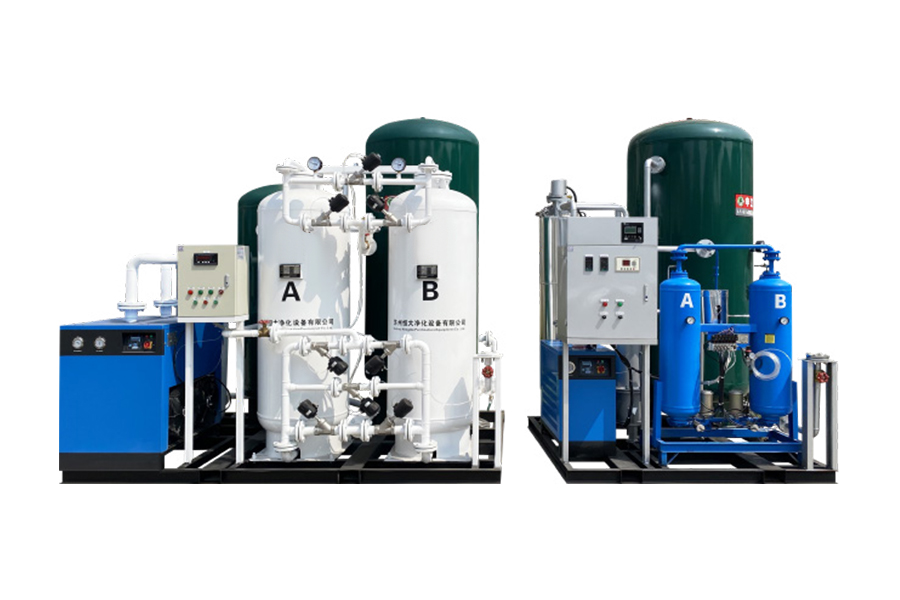
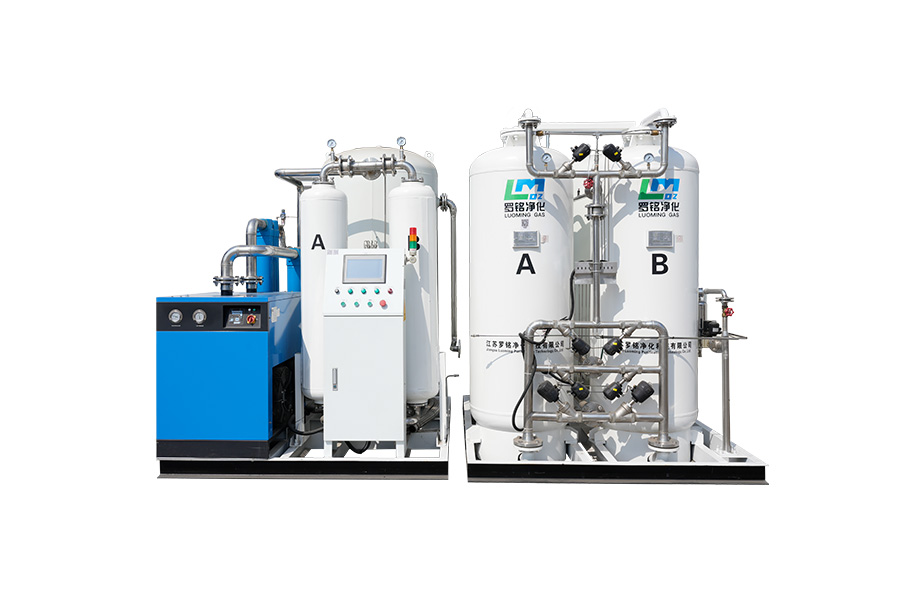
A single adsorption tower would need to stop and vent periodically to release the trapped nitrogen, which means gaps in supply. That's why practical systems run two towers in parallel: one adsorbs and produces oxygen while the other depressurizes and regenerates, then they swap roles. A PLC controller manages the pneumatic valve timing between towers precisely enough that output never actually stops. This dual-tower architecture is the backbone of most modern oxygen generators built on PSA separation, and it's why they can run continuously for years with only routine maintenance.
Purity That Matches the Job — Medical vs Industrial
Not every application needs the same oxygen concentration, and chasing unnecessary purity just adds cost. PSA systems typically deliver output in the 90–95% range, with the remainder made up of argon and trace gases.
Typical PSA oxygen output compared across use cases
| Application |
Typical Purity |
Why |
| Hospital respiratory therapy |
93% ± 2% |
Matches medical monograph requirements |
| Aquaculture, wastewater treatment |
90–93% |
Enough to boost dissolved oxygen levels efficiently |
| Metal cutting, combustion support |
90–95% |
Higher purity improves flame temperature and cut speed |
For clinical settings, purity isn't the only variable that matters — consistency under fluctuating demand does too, which is why medical-grade oxygen gas generators are engineered with tighter tolerances and continuous monitoring compared to their industrial counterparts.
What to Check Before You Choose an Oxygen Generation System
Sizing comes first. Undersize the unit and you'll be back to renting cylinders during peak demand; oversize it and you're paying for compressor capacity you never use. Look at your actual peak flow requirement in Nm3/h, not your average.
- Confirm the purity range matches your regulatory or process requirement — don't overpay for medical-grade purity on an industrial line
- Check compressed air quality upstream; moisture and oil contamination shorten molecular sieve life significantly
- Ask about PLC diagnostics and remote monitoring, which cut maintenance response time
- Factor in payback period — most facilities recover the equipment cost within twelve to twenty-four months versus continued cylinder spend
Getting this right usually means working with engineers who can model your actual air quality, flow pattern, and facility layout rather than selling a fixed catalog size. That's the difference between buying equipment and getting a complete oxygen generation system tailored to your application.





 English
 русский
 Français
 Español
 عربى
عربى