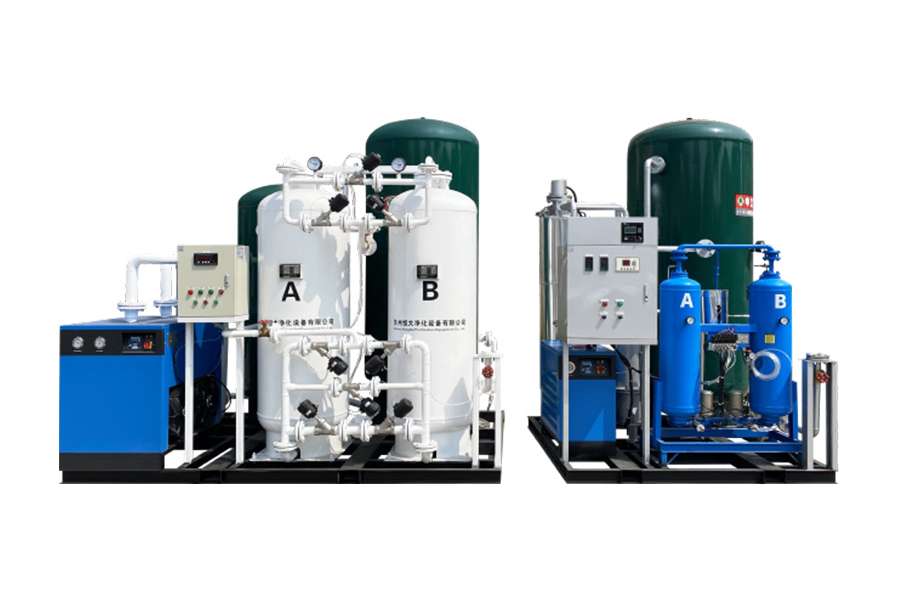
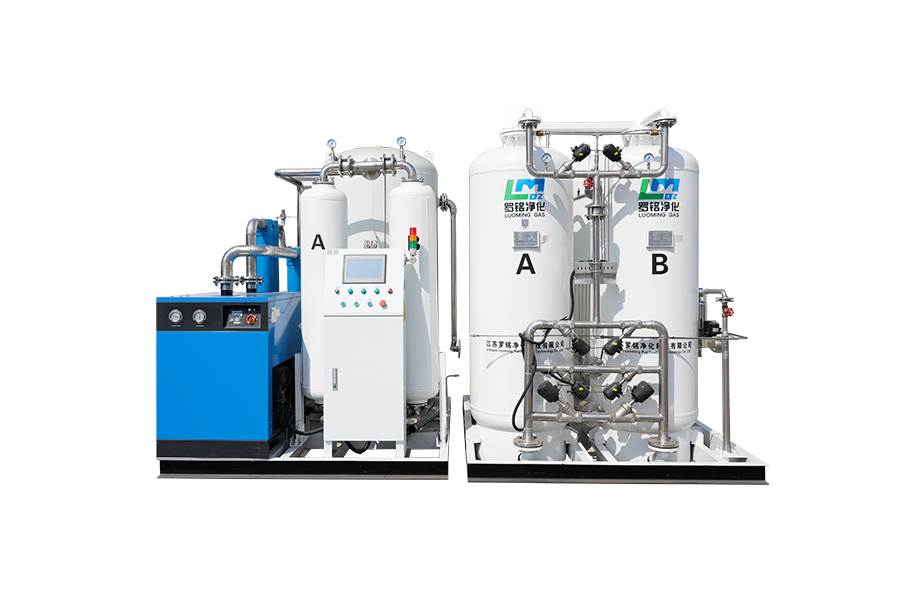
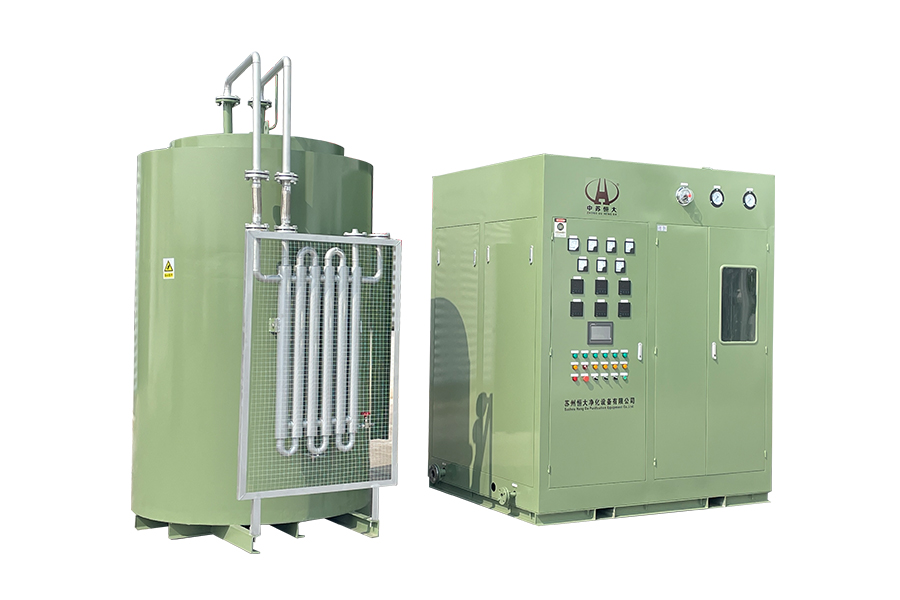
One 40-litre cylinder at 150 bar carries roughly 6 cubic metres of oxygen. A single ventilated ICU bed can pull that down inside a day, and the delivery truck does not care about snow, road closures or ward schedules. That arithmetic is why hospitals, sanatoriums and high-altitude clinics move to a PSA medical oxygen generator: a plant-room unit that makes its own oxygen from ambient air.
The engineering question is not whether on-site generation works, it has been routine practice for decades, but which configuration matches your patient load, your purity requirement and your building.
90 to 96%typical medical PSA purity
3 to 100+ Nm3/hcapacity range for clinical plants
4 to 5 barusual ward pipeline pressure
What a PSA medical oxygen generator actually is
A PSA medical oxygen generator is an on-site plant that separates oxygen from compressed air by pressure swing adsorption, delivering a continuous 90 to 96 percent oxygen stream at ward flow rates and pipeline pressure. It needs electricity and clean compressed air; no chemicals are burned and no cryogenic tank is involved.
Pressure swing adsorption is a cyclic separation: a zeolite molecular sieve holds nitrogen preferentially at 5 to 8 bar and releases it when the pressure drops. Two beds run out of phase, so one produces while the other regenerates.
The principle matches a bedside concentrator, but the scale and the paperwork do not. A clinical plant runs from roughly 3 to more than 100 Nm3/h, with duplex blowers, dual analysers and an alarm interface to the nurse call or building management system.
The medical version is also a regulated device. Jiangsu Luoming, the manufacturer behind this site, obtained its Class II medical device production licence at the end of 2022, and that licence is the baseline for supplying oxygen equipment into patient care rather than into a workshop.
Purity, flow and pressure: the three numbers that decide everything
Every medical PSA plant is specified on three numbers, oxygen purity, flow in Nm3/h and outlet pressure in bar, and sieve volume, compressor size, buffer capacity and booster choice all follow from them.
Typical design values for a medical PSA oxygen plant and the consequence of getting each one wrong.
| Oxygen purity |
90 to 96 percent |
Below 90 percent fails the oxygen-93 monograph |
| Flow |
3 to 100 Nm3/h |
Peaks and future beds need headroom, not exactly matching |
| Outlet pressure |
4 to 5 bar |
Far-end ventilators alarm when pipe losses eat the margin |
| Dew point |
about minus 46 C |
Moisture corrodes pipework and skews the analyser |
| Carbon monoxide |
5 ppm or less |
Exhaust near the intake passes straight to the patient |
| Carbon dioxide |
300 ppm or less |
Signals exhausted sieve or failed pre-treatment |
Ask how the flow figure was measured. Quoting at 0 C or at 20 C changes the number by about 7 percent, and some catalogues include purge oxygen while others do not. Pressure belongs at the furthest outlet rather than at the skid: a 4.5 bar machine feeding a long ward run can leave intensive care at 3.5 bar with a flow alarm.
Purity is a chain, not a setting. Sieve quality, dew point, cycle time and analyser calibration each pull the result down. If 99.5 percent is required, a second purification stage is added after the adsorption beds; it is not achieved by running the same plant harder.
That is why analyser choice matters as much as bed size. A trace oxygen cell on the outlet and a dew point sensor after the dryer give the maintenance team the two readings that explain most purity complaints before a nurse ever notices them.
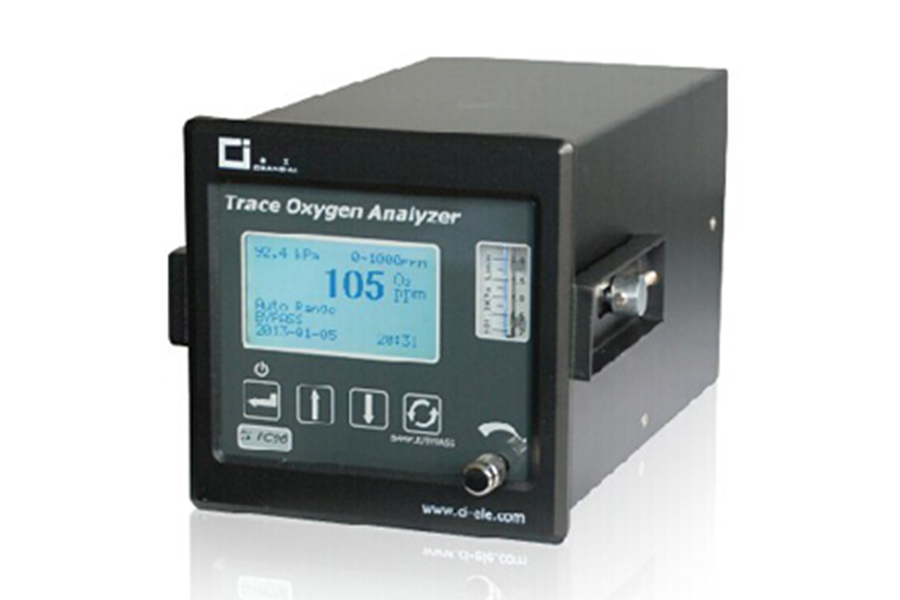 CI-PC96 Trace Oxygen Analyzer for PSA Oxygen Purity MonitoringFuel-cell trace oxygen analyzer with multiple ppm and percent ranges, over-range protection and communications, suited to monitoring oxygen purity where PSA plant readings matter.View Product →
Inside the system: from ambient air to a ward outlet
A medical PSA oxygen plant is five sub-systems in series, and the weakest of them sets the purity that reaches the patient.
Compression and air quality
An oil-free or well-filtered compressor delivers 7 to 8 bar. Intake placement matters: a loading bay or diesel exhaust nearby shows up as carbon monoxide in the product gas.
Drying and filtration
Refrigerated and desiccant drying plus coalescing and carbon filters bring the air to a dew point the sieve tolerates. Wet air is the fastest way to destroy molecular sieve.
Twin adsorber beds
Zeolite fills two vessels that alternate every few tens of seconds. A sticking valve usually appears as a slow purity drift, not as a clean shutdown.
Buffer storage and analysis
A receiver smooths the pulsed output and gives the analyser time to react. Automatic diversion protects patients when purity falls below the set point.
Delivery or filling
Most hospitals take oxygen at 4 to 5 bar into a copper or stainless pipeline. Sites that also fill cylinders add a high-pressure booster and a filling ramp.
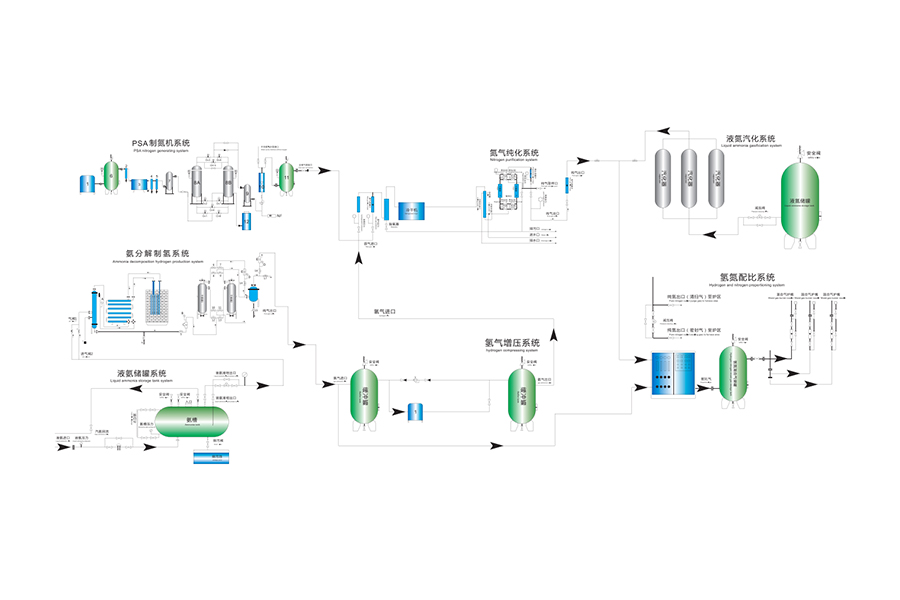 Customizable On-Site PSA Gas Production SolutionConfigurable PSA nitrogen and hydrogen protective-gas station, adjustable to site process needs and intended to reduce investment and usage costs.View Product →
Redundancy is a specification item. Two 60 percent compressor trains usually cost less over ten years than one oversized train plus cylinder deliveries every time the plant is serviced.
PSA versus cylinders and liquid oxygen
On-site PSA has the lowest cost per cubic metre and the highest supply security; cylinders have the lowest capital outlay; liquid oxygen needs the least floor space.
Cylinders
- Low entry cost, quick to start
- Recurring transport, handling and rental fees
- Supply depends on roads and weather
- Stock rotation and manifold leaks to manage
Liquid oxygen
- Compact storage for very large demand
- Evaporation losses from the tank
- Long delivery chain, single point of failure
- Practical only at high daily volumes
On-site PSA
- Cost per cubic metre fixed after installation
- No road dependency once commissioned
- Purity limited to 90 to 96 percent unless purified
- Needs power, a plant room and maintenance
Typical oxygen purity by supply mode
Cylinder supply 99.5%
Liquid oxygen 99.6%
PSA plant 90 to 96%
PSA with purification 99.5%
A 100-bed hospital using 1,500 cubic metres of oxygen a month is buying roughly 250 cylinders. That number, not the equipment price, is what on-site generation removes from the budget.
Sizing the plant and preparing the room
Size the generator on peak ward demand plus a growth margin, then confirm that the room can carry the compressor, the buffer tanks and the heat load.
4 to 5 barpipeline delivery at the furthest outlet
0.4 to 0.6 kWhtypical energy per cubic metre of 93 percent oxygen
8 to 10 yearssieve life with good air pre-treatment
20 to 30 mincold start before purity stabilises
Peak demand is usually set by theatres and intensive care rather than by bed count. A ventilator can draw 40 to 60 litres a minute on its own, so a 20-bed unit may need the same flow as a 60-bed general ward.
- Power: dedicated supply with a clean earth and correct voltage tolerance
- Space: skid footprint plus service access on all sides
- Ventilation: heat rejection from compressor and dryer, not only the adsorbers
- Air intake: away from vehicle exhaust, dust and kitchen extract
- Pipework: sized for peak flow with a pressure drop budget of about 0.5 bar
Rule of thumb: specify for the peak hour, not the average day. Oxygen demand in a hospital swings by a factor of three between 03:00 and a busy morning round.
Maintenance, consumables and the real running cost
Electricity and molecular sieve dominate lifetime cost, and both are decided at the specification stage rather than during service.
Filters are the cheap, frequent item: coalescing elements every three to six months, carbon filters annually, analyser cells every 12 to 24 months. Valve rebuilds and sieve top-ups depend on cycle count and air quality. A plant fed by a well-maintained dryer will run a decade on its original sieve; one fed by a tired dryer will not.
Budget energy, not parts, as the main operating line. A plant drawing 45 kW for 6,000 hours a year consumes about 270,000 kWh, which outweighs sieve replacement several times over.
Service access deserves as much attention as the equipment list. A skid pushed into a corner with 300 mm clearance will cost more in delayed maintenance than a larger room would have cost to build.
Specifying the project and choosing a supplier
Write the specification around patient load, turndown and service access, then match it to a supplier who can document the medical claim rather than only the flow rate.
Ask for the purity test method, the alarm logic, the analyser calibration interval and the name of the engineer who will attend commissioning. Hospitals that run oxygen plants well tend to have settled those four items before the purchase order, and the medical industry application notes on this site set out the ward-side requirements in more detail.
If you also fill cylinders
Many district hospitals generate oxygen and fill their own cylinders for backup and for satellite clinics. That adds a high-pressure booster, a filling ramp, a manifold and a second purity check at the point of fill. A dedicated medical on-site oxygen filling system is easier to validate than a booster bolted onto a plant that was never designed for it.
 Oil-Free High-Pressure Oxygen Booster Compressor for Cylinder FillingOil-free booster stated for 150–200 bar oxygen cylinder filling, relevant to oxygen charging stations and on-site filling setups.View Product →
Jiangsu Luoming was founded in May 2020 as a subsidiary of Suzhou Hengda Purification Equipment, reports a 16,000 square metre site and more than 200 staff including 52 in research and development, and builds medical molecular sieve oxygen generators, PSA oxygen generator, 99.5 percent high-purity plants, containerised systems, plateau dispersion generators and portable respirators. That spread makes it easier to fit a plant to an awkward building or a remote clinic than to bend one standard model into shape.
Buy the commissioning report, not the brochure. Purity, dew point, carbon monoxide and flow, measured at the outlet under load, are the only numbers that describe the plant you actually own.
Frequently asked questions
What purity does a PSA medical oxygen generator produce?
Most clinical plants deliver 90 to 96 percent oxygen, commonly quoted as 93 percent with a tolerance of about 3 points. Higher figures such as 99.5 percent require an additional purification stage after the adsorption beds.
Can on-site generation replace cylinders completely?
For normal ward demand, yes. Most hospitals still keep a cylinder manifold or a small reserve for outages and patient transfers, and regulators in many countries require a backup supply.
How long does a plant take to start?
A cold start usually reaches stable purity in 20 to 30 minutes, depending on bed size and buffer volume. After a short stop the plant recovers faster because the sieve is already conditioned.
What maintenance does it need?
Filter changes every three to twelve months, analyser calibration every six to twelve months, valve inspection by cycle count, and sieve replacement after eight to ten years of good air quality.
If the site loses power, the plant stops producing within seconds. Specify the backup supply and the cylinder reserve together, and test the changeover while the wards are awake.





 English
 русский
 Français
 Español
 عربى